Nasal Breathing During Training
More and more athletes are discovering the benefits of breathing through the nose while they train.

More and more athletes are discovering the benefits of breathing through the nose while they train. Here's a 4-week plan to ease into it, what runners get out of it, and some practical tips along the way.
Why are athletes switching to nose breathing?
For decades, athletes were told to breathe through their mouths — more air in, better performance, simple as that. But recent research points the other way: breathing through your nose during exercise comes with some surprising payoffs. The nitric oxide produced in your sinuses improves how oxygen gets carried to your muscles. Nose breathing also forces your body to use the oxygen it already has more efficiently, and over time that pushes your endurance up. Athletes like Sifan Hassan and Eliud Kipchoge are known for breathing through their noses while they push hard.
The physiology of nasal breathing under load
When you're working out, nose breathing fires up the diaphragm far more than mouth breathing does. The diaphragm is your most powerful breathing muscle — get it fully engaged and you get deeper breaths, better gas exchange, and a more stable core. Nose breathing also keeps your CO2 at an optimal level, which, oddly enough, helps deliver more oxygen to your tissues (that's the Bohr effect). One study on athletes found that after six weeks of training with nasal breathing, their VO2 max didn't drop at all — but their breathing efficiency went up by 22%.
How to start — a 4-week plan
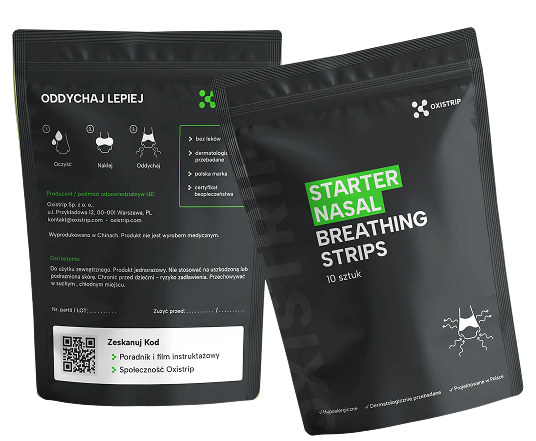
Weeks 1-2: Start easy — walks, light jogging, yoga. Breathe through your nose only. If you have to open your mouth, back off the pace. Week 3: Bring nasal breathing into moderate-intensity sessions. Run at a pace that lets you keep breathing through your nose. Week 4: Try nose breathing during harder workouts. Let yourself breathe through your mouth during intervals, but come back to nose breathing between sets. Oxistrip Sport strips can help keep your nose open the whole time.
Nasal breathing for running
Running is where nose breathing pays off the most. When you breathe through your nose while running, you automatically match your pace to your breathing capacity — it's a built-in intensity regulator. Your pace will drop 15-20% at first, but after four to six weeks it comes back to normal, and your fitness keeps climbing from there. The key rule: run at a pace where you can breathe through your nose the entire time. If you're gasping through your mouth, you're going too fast. Have a look at our roundup of the best nasal strips for running and sport, too.
Nose breathing at the gym
In the weight room, nose breathing helps you keep your deep stabilizing muscles tight and control intra-abdominal pressure. During strength work: breathe in through your nose before the rep, brace your core, then breathe out through your nose or mouth on the concentric phase. Between sets, breathe calmly through your nose — it speeds up recovery. For heavy strength attempts (over 85% of your 1RM), mouth breathing is fine for the sake of safety and maximal effort.
Nasal strips in sport — do they actually work?
Nasal strips like Oxistrip Sport are catching on with athletes around the world. Mechanically opening up the nostrils cuts airway resistance by 30-40%, and that's especially noticeable when you're working hard. A 2025 study on 80 amateur runners found that wearing nasal strips during training improved their perceived breathing comfort by 40% and stretched their time to exhaustion by 8%. Strips are allowed in every sport.
The most common mistakes and how to avoid them
Switching to nose breathing too fast during intense sessions can leave you frustrated and even hypoxic. Nose breathing doesn't mean you never open your mouth — during sprints or heavy intervals, mixed breathing is natural. Don't force nose breathing when you've got a cold — a blocked nose makes it unsafe. And give it time: the habit takes four to eight weeks of regular practice to stick. You'll find the research on nasal breathing in sport and sleep on our Science page.